Showing posts with label history. Show all posts

Sunday, 17 January 2016

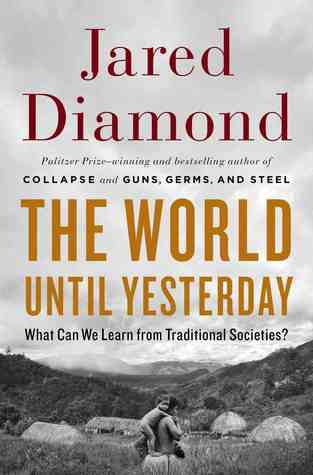
'The World Until Yesterday' by Jared Diamond


The World Until Yesterday: What Can We Learn from Traditional Societies?

I've just finished 'The World Until Yesterday' by Jared Diamond, and more than most books I've ever read, I want to share this with others.

Jared Diamond is a writer and scientist, who has spent decades researching the indigenous tribes of Papua New Guinea (this is obviously his area of expertise, but he's done a lot of research into other indigenous cultures all across the world for this book). He's most well known for his book 'Guns, Germs and Steel' about how Europeans came to dominate the world (for the answer to that, the clue is in the title!). He seems a fascinating man with a great mix of interests and fields of study. The bio on his website is definitely worth a read if you want to know more.
The book is a non-fiction book that doesn't neatly fit into any category, but instead I'd say it is a mix of geography, history, anthropology, with a bit of philosophy, science, memoir and no doubt various other things in it. The central concept of the book is looking at many different traditional societies to examine their approach to various different aspects of everyday life including crime and punishment, religion, languages, bringing up children, dealing with the elderly and diet and lifestyle. The book is called The World Until Yesterday because by examining traditional cultures around the world, many of them hunter-gatherers, the book is also examining the way all of our ancestors lived, until about 10,000 years ago (i.e. for most of 200,000 or so years that modern homo sapiens have existed for).

This concept is one that greatly interests me, because although there are many different cultures around the world, in many respects we are starting to live in one giant culture, because the vast majority of the world (certainly the Western World, but increasingly a lot of the rest too) operates very similarly in terms of the way it is run, the way people act and live out their lives. This is as a result of European colonisation in the 16th-19th century, and the spread of globalisation and American consumer culture in the 20th and 21st centuries, It is easy to assume the way people are is the only way we could be, when it is simply not true.

So the premise is one I really like, but how well did the author manage to fulfil my expectations? While not all topics are equally good (the crime and justice section at the beginning seemed to drag after a while), it was all fascinating and enlightening. The section on health was particularly excellent. Some of the conclusions were new and surprising to me, others more familiar but still had many new insights. For a knowledge junkie like me, this book was manna from heaven.

Here's a couple of quotes/facts I picked out from the book.

"Looming behind this increasing social isolation of the modern elderly is that they are perceived as less useful than were old people in the past, for three reasons: modern literacy, formal education, and rapid technological change."

"the Inuit themselves abandoned war in their own self-interest in order to have more opportunities to profit from trade, and the !Kung may have done the same"

"Roman soldiers were paid in salt, so that our word “salary” for pay is derived not from the Latin root for “money” or “coins” but from the Latin root for “salt” (sal)." [Not particlarly relevant to the thread of the book, but a fact is a fact, I never turn them down!]

"Around the year 1700 sugar intake was only about 4 pounds per year per person in England and the U.S. (then still a colony), but it is over 150 pounds per year per person today."

This wasn't the lightest read, but it wasn't particularly difficult either. I should give a shout out to the wonders of the Kindle - I did start reading this over a year ago but put it down after getting bogged down in the first section (on crime and justice). I picked it up again a couple of weeks ago, and was able to go straight to where I left off. If this had been a paper book I'd probably have taken it to the charity shop ages ago and never picked it up again!

Really enlightening and fascinating book. There were some areas I felt he didn't touch on much that I'd have liked to read about - such as more about the politics and economics of traditional cultures but maybe that is for another book. Still, for a knowledge junkie like me, this book was manna from heaven. 9/10

Wednesday, 9 September 2015

Review of 'Amsterdam: A History of the World's Most Liberal City' by Russell Shorto

This is one of my three holiday reads, from recent holiday to Amsterdam & Paris. I started each of the three books either just before or while on holiday, but finished none of them. Holidays after all are about more than just reading. This was the last one to start, and I began (or picked up where the sample left off anyway) when in Paris the day before catching the train to Amsterdam. Part of the reason for picking it was to learn something about the history of Amsterdam to better enjoy the visit, so thought I should really start before I got there! I consequently read this straight through, and didn't put down for another book.

Anyway, on to the book. This is a narrative history book, relating the story of Amsterdam from its founding in medieval times right through to the present day. It's also an exploration of the concept of liberty, which Amsterdam has for much of its existence stood at the forefront of. If this sounds a bit high brow and technical, don't worry. While the author shares some interesting views on this, it doesn't get in the way of the main event of telling the history of Amsterdam. It just gives it a subtle extra flavour, and adds a bit of weight to the book. The story of the city it told chronologically, picking up all of the important stuff along the way, and offers us portraits of some of the most significant figure in its history. The main chunk of the book covers Amsterdam's struggle against its Spanish Catholic overlords in the 16th century, and the city's subsequent golden age in the 17th century when it was arguably the richest and most powerful city in the world. This is probably the best part of the book, but the section of Amsterdam during and either side of World War 2 is also excellent. The story of Anne Frank is of course covered, but we also get the story of another girl, Frieda Menco, who used to play with Anne and her sister, who survived the war and recently told her story to the author of this book.

The author has an insider-outsider viewpoint which I find quite useful - insider knowledge but maintaining an outside perspective to properly be able to see the bigger picture. He's an American, but has lived in Amsterdam for a number of years. He's obviously undertaken a lot of research, but also conducted in depth interviews with Amsterdamer's which really add significantly to the last part of the book.

As well as this one, his other major book which was written a few years earlier is 'The Island at the Center of the World', a brilliant narrative of history of the founding and early history of New York (originally New Amsterdam as it was founded by the Dutch). Despite covering a much wider time frame, 'Amsterdam' is a significantly smaller book in size and scope. It doesn't quite reach the heights of the author's previous work, but is still a great read.

In conclusion, this is a great book if you are looking to visit Amsterdam or interested in its history at all. There are few cities that can lay claim to the historical significance or legacy of Amsterdam, and its achievement is all the more amazing because of the short time in which it did it. The smaller stories in the book are excellent too, my favourite probably being the story about the heroics and ingenuity of Dutch resistance members during World War 2, particularly Wally Van Hall.

Really recommended, 9/10.

And Amsterdam itself? Would I recommend that as a place to visit? Well that depends. If you really like your history then definitely. It has amazing history, beautiful architecture and a lovely canal network with great boat tours. It has its seedy side too, which you can't help stumbling over from time to time (okay quite a lot really), so you'd need to not be worried about that if you were going to enjoy the city. It's got great museums, including the Amsterdam Museum which is all about the history of the city, and lots of old canal houses which you can look round.


You don't even need to go round any museums to appreciate the history though, just by walking round seeing all the old buildings will do that for you. Look out for the pictoral signs on building facades, there's lots of really interesting ones.

Final words of advice? If you are going to visit Amsterdam, be careful not to get run over by bikes - they are everywhere (they have their own dedicated cycle lanes which look a lot like pavements - be warned). Oh and take this book with you, and you'll be wowing your friends and family with fascinating tales of Amsterdam's history.

Monday, 24 August 2015

So Just Who Was Mad King Ludwig?

Following on from my review of the board game 'Castles of Mad King Ludwig' yesterday, today I'm going to have a bit of a delve into the theme and a bit of history to find out just who Mad King Ludwig was, and whether he really was mad.

Who Was Mad King Ludwig?

The eponymous mad king was in fact Ludwig II, King of Bavaria, sometimes known to history as the Swan King or the Fairy Tale King. He succeeded to the throne when he was only 18, after the death of his father (as an interesting aside for board gamers, as a young man his aide-de-camp and close personal friend was Prince Paul, a member of Bavaria's wealthy Thurn Und Taxis family. But that is for another time).

When Ludwig ascended the throne in 1864, he really wasn't ready for high office and simply wasn't interested in politics or affairs of state, much preferring his passions for art, architecture and music. He was a longtime friend and patron of Richard Wagner, the famous composer most known for his epic Ring Cycle. It is thought by many that without the support of Ludwig, Wagner would never have been the success he was.

Before we get on to Castles, a brief history lesson. At the time Ludwig became king, Bavaria was a separate independent kingdom, but not for long. Bavaria became embroiled in the Austro-Prussian war in 1866, unfortunately picking the wrong side. Bavaria sided with Austria, but when they were defeated, Bavaria had to sign a mutual defence treaty with Prussia which effectively meant Bavaria was under Prussian control. In 1870 after another war (the Franco-Prussian war), Bismark set about completing the unification of Germany. He gave certain financial inducements for King Ludwig to sign the Kaiserbrief, a letter endorsing the creation of the German Empire. Bavaria thus became a part of the German Empire which, while Bavaria was left with a certain degree of autonomy, left Ludwig free to pursue his favourite hobby - building Castles!

Neuschwanstein


The most famous of Ludwig's Castles was Schloss Neuschwanstein, a Romanesque Revival palace on a rugged hilltop, overlooking Ludwig's childhood home of Hohenschwangau. 

Like Ludwig's other projects, Neuschwanstein was paid for from his personal fortune (as well as a few loans!), and Ludwig oversaw every little detail of the design and construction. It was built to be decorative rather than functional and was inspired by the works of Ludwig's friend Richard Wagner. It was supposed to have more than 200 rooms, but only 15 of them were ever finished, including the 'Hall of the Singers', The Throne Hall. The Bedroom and the Study Room.

Since Ludwig's death, the castle has been an extremely popular tourist attraction, with over 60 million people having visited it to date. It was also the inspiration for Disney's Sleeping Beauty Castle.

Linderhof Palace

Linderhof is the smallest of Ludwig's castles, and is the only one he lived to see finished. It took as its inspiration Versailles, the Palace of the French Sun King, Louis IVX (who Ludwig idolized). There were only four rooms of any significance: The Hall of Mirrors, The East and West Tapestry Chambers and the Audience Room (in which Ludwig never had an audience).


Herrenchiemsee

Herrenchiemsee was a Benedictine abbey which was created in the year 765. It was eventually purchased by Ludwig and turned into a royal residence known as the Old Palace. Not content with that though, Ludwig also built Herrenchiemsee Palace, which became known as the New Palace. It was never finished, but it took inspiration from, and was a partial replica of, the Palace of Versailles in France.

Ludwig's Death

Despite the fact he never used public funds for any of his building projects, Ludwig was extremely unpopular with his ministers, perhaps because he wasn't interested in governing, or because he was in a lot of debt after borrowing money from many of the royal families of Europe. His ministers sought to depose him, and did so by accumulating evidence that he was in fact insane and not fit to rule. The conspirators then approached Bismark with their 'findings' which he likened to "rakings from the King's waste-paper baskets and cupboards", but didn't actually do anything to stop them.

Only three days after he was deposed, Ludwig was out taking a walk in the grounds of Berg Castle where he had been taken, with a Doctor Gudden (one of the doctors who declared him insane). Neither of them were seen alive again, and their bodies were later found in a lake in the grounds). The doctor showed signs he had been strangled but there was nothing to suggest how Ludwig died. The mystery of Ludwig's death has not been solved to this day.

So Was King Ludwig really mad?

At the fact the time, no one really refuted Ludwig's insanity, but since them historians have considered the case in more detail and many have concluded that the evidence was largely fabricated. The records of the case were even studied by psychiatrists, and findings published in the journal 'History of Psychiatry' concluded he wasn't insane, only eccentric.

How Closely Has the Game Stuck to the Theme?


The game doesn't really have anything much to do with Ludwig himself, but in one sense it has stuck closely to the theme. The artwork on the box is of (or closely resembles) Ludwig's masterpiece, Neuschwanstein. The rambling nature and strange configuration of rooms which players end up creating in the game somehow fits well with the eccentricity of Ludwig as well.


The game sticks closely to the theme in the type of rooms which are in Ludwig's castles, or would have been if he had been able to finish them. In particular there are some specific rooms featured in the game which are taken directly from Ludwig's Castles, including the Tapestry Rooms, the Audience Chamber and the Singer's Chamber.

Overall, a great theme for a great game.


Thursday, 2 July 2015

The Human Story

What I'm Reading: The Penguin History of the World (33% through)
What I'm Watching - Castle Series 7
What's Cooking? - Paprika Beef & Sweet Potato Pie

I've always found it hard to reconcile the different interests I have, and nowhere is this more pronounced than it what I choose to read. My tastes shift from time to time and in any given week are influenced by how busy or stressed I am, but can be just about anything (excluding celebrity biographies and Mills & Boon perhaps!). On the fiction side I usually prefer science fiction, some historical fiction, and the occasional bit of contemporary veering towards literary fiction. On the non-fiction side it tends to be history, science, travel and a few other odds and sods.

The biggest contrast I always think is between history (-fiction) and science (-fiction), particularly when these sum up the core of what I like to read. Then it finally occurred to me the other day that they are far more similar than you might think. What links them, and what I love about both of them, is the idea of what I think of as The Human Story. History is all about what we humans got up to in the past, how we got where we are today. When you stop to think about it, the story is frankly an incredible and wondrous one in such a short fraction of a second in geological or cosmic time. Science, and especially science fiction, is forward looking and asks how might the human story continue in the centuries and millennia ahead? Thinking about this is every bit as exciting and wondrous as the story of how we got where we are today.

Well my reading tastes have - for now at least - shifted a little back to history (though one of the books I'm so looking forward to coming out this month is a science fiction one- more on that later). A visit to a museum recently gave me a hankering for history again. I started 'A History of the World in Bite Sized Chunks', but it was far too bite-size and not meaty enough for what I wanted, so I instead picked up 'The Penguin History of the World 6th edition' by J.M. Roberts and Odd Arne Westad. At well over 1,000 pages it is quite a read, but at least I've got it on Kindle to save me lugging all that paper around. History is so full of great stories, and I hope to share some of them with you soon.

A couple of books I'm looking forward to this month couldn't be more different from each other (and the book I'm reading):

'Go Set a Watchman' by Harper Lee - One of my favourite ever books is 'To Kill a Mockingbird' by Harper Lee. I think it helped that I read it as an adult and not at school, as most people who read it school didn't seem to appreciate it. It is one of great classics of the 20th Century, set in the 1930s Deep South and dealing with racism that was endemic in the American South at that time. It is the only book published by the author... until now. More than half a century later, she is releasing 'Go Set a Watchman' which is a kind of sequel, although it was actually written before To Kill a Mockingbird, and deals with the child characters Scout and Jem as adults. The book is published on 14 July.

'Armada' by Ernest Cline. A couple of years ago I read 'Ready Player One', Cline's first book and absolutely loved it. It was science fiction, and also a 1980s nostalgia fest. I've never read anything like it before. Well now he's written another one 'Armada'. This book is about a science fiction geek who really wishes he could help save the world like he does in computer games. Only now an alien fleet has arrived in orbit and needs his (and other people's) help to save the Earth. This one comes out two days after 'Go Set a Watchman' so I'm going to have a busy time reading! I'd also better get cracking on The History of the World, as I've still got about 800 pages to go...

Lastly for now, I've started a new feature on my blog, What I'm.... to let any blog readers out there what I'm upto, whether that's what I'm reading, listening to, watching, drinking. Will vary it depending on what I'm doing. And while I'm only an occasional cook, I did cook Paprika Beef & Sweet Potato Pie, a Pampered Chef recipe, and it was yum!


Tuesday, 31 July 2012

History Books - Web Resources

I'm always on the look out for great new history books, but searching on the internet for good information is quite difficult. There's lots of information on historical fiction, but not much for non-fiction popular history books, and when you do come up with something there's invariably a lot of historical fiction mixed in. Here's a few websites I've come up with that you might find useful.

http://www.historyextra.com/books - This is the books section of BBC History Magazine. There are hundreds of reviews from books reviewed in their magazine over the last few years, and you can browse and search by category or keyword. They're also starting book lists by asking leading historians to suggest five books on a particular topic.

Reddit History Books List - On Reddit (a social bookmark & link sharing site), the 'Ask Historians' subreddit community came up with a list of the best history books, by category and era. There's a lot of great books on there, and as well as the list you can see the discussion that is behind it. I even contributed a few books to that list. Obviously this is only a very small selection of the great books in each category available, but its useful to look at for inspiration as to what to read next or what you've missed before.

http://www.lovereading.co.uk/genre/his/History.html - LoveReading is a lovely site with hundreds of book reviews, book extracts/first chapters and more. In each genre (which includes non-fic history) they choose a few books each month to review and provide extracts for, which as it has been going for years means quite a big back catalog!

Goodreads History Book Club - This is a very active forum and book group (probably the most active history book forum online) that reads all sorts of history books - mostly non-fiction. They have several books the group reads each month and then discusses, as well as a variety of challenges. If you want to though, you can just browse the forums and join in whenever you like.

History Books Review Blog - I'm always on the look out for good blogs, and I've recently come across that one which is really good. This guy's been posting regularly for about 5 years which is a very good sign in my book!

I'll be updating this as and when I find other good web resources, and if you know of any please let me know and I'll add it.