Showing posts with label book reviews. Show all posts

Friday, 3 March 2017

A Trio of Classic Science Fiction Novels

I'm steaming ahead with my book challenge at the very least, 10 books so far out of my target of 40. According to Goodreads I am 4 books ahead of schedule, though I feel like I will be losing some ground over the next few weeks as I'm about a quarter of the way through the 950 page Tolstoy opus, Anna Karenina. Anyway back to the science fiction.

The Caves of Steel by Isaac Asimov


The Caves of Steel is the first book in Asimov's Robot series, which has multiple novels and many short stories in it. This book takes place in the near-ish future, at a time when robots were still in their infancy. Most robots in this book are dumb things, not a great leap from artificial intelligences of today. This book features detective Elijah Baley, and possibly the first of the truly intelligent robots, Daneel Olivaw. An important ambassador has been murdered, and it is Baley and Daneel's job to investigate the crime and discover the culprit, to prevent a greater crisis.

This book has been on my to be read list for a long time now, and I finally got around to it after picking up a cheap paperback copy. The detective story itself is quite a basic one, but it was the world building and the great ideas that really got me hooked on this book. Considering it was written in (checks Wikipedia) 1954, it has aged really, really well. Okay so the computers they are talking about are pretty basic and possibly involved punched cards, and some of the numbers are a bit off (the 8 billion population may be several times that of Asimov's era, but today's population is close to that) but otherwise it is very believable. The political/social system described is bordering on communist, but is still quite believable, and some of the technology was a delight (I loved the idea of the moving walkways where you stepped from lane to lane, which increase in speed each time). Overall, a great, short book, still very relevant and enjoyable today and a good start to his Robot series.


The Space Merchants by Frederick Pohl & C M Kornbluth


This is a 1950's classic science fiction novel by the writing team of Frederick Pohl and C M Kornbluth. Ad man Mitch Courtenay is at the top of his game, and has been given the plum assignment of managing the Venus contract - promoting the new colonisation of Venus to ensure that his agency exclusively controls the spending of the would be colonists. In this imagined future, the world is effectively controlled by three giant advertising companies, the leaders of which are more powerful even than the US president. The ad men are rich, powerful and can have whatever they want, the consumers however are a downtrodden underclass...

This is a short novel, and in keeping with most science fiction of this era, it is desperately short on good characterisation - the characters are quite two dimensional almost just ciphers to move the plot along. The plot itself is also somewhat pedestrian, although with a twist at the end. I have to say however I really enjoyed this book. Although it is really dated, having been written over 60 years ago it has some very interesting technology and even the dated aspects of the novel hold a certain interest - in many ways the future the authors portrayed is already here. A lot of the scary stuff is a lot closer now than it was in the 1950's and even the stuff they got wrong casts light on the present. A great read.


The Stainless Steel Rat by Harry Harrison


In the far future, criminal intent, violence and deviousness has been bred out of the human race. Once in a while though someone slips through the genetic net. James Bolivar diGriz a.k.a. Slippery Jim is such a person. He is a master criminal and a brilliant disguise artist with a cunning mind, always staying several steps ahead of the law. Until...

This is the first in a science fiction comedy series, begun in the 1970s by the prolific science fiction author Harry Harrison. It was written, I think, as a spoof of the early space opera series by the likes of E E Doc Smith. I've never been a big fan of comic science fiction, or comic fiction generally, but it gives the author a lot of freedom to disregard the rules of science or sense and just have fun. I really enjoyed this, it was a great fun read. Incidentally, rather than reading this I listened to the audiobook from Brilliance Audio (on Audible.co.uk) and I thought it worked great as an audiobook and the narrator did a really good job.


That's it for now. I've just ordered several of the SF Masterworks so I'll be covering them in a later post. Before that, Hemingway and Tolstoy amongst others!


Thursday, 25 February 2016

'Europe: In or Out: Everything You Need to Know' by David Charter

Now that the date of the Referendum on Britain's membership of the EU has been announced, I wanted to read up on the relevant facts and arguments, to be able to make an informed decision (okay so I'd effectively already made a decision, but wanted it to be informed nonetheless!) and to arm myself for debates/arguments in the next few months. Anyway, after looking at a number of books about the EU referendum, I settled on 'Europe: In or Out' by David Charter who is a renowned journalist, the Berlin correspondent for The Times.

The book is well set out and each chapter covers a different theme / policy area, with key facts, the arguments for leaving and for remaining, as well as a general discussion with examples. There were chapters covering immigration, the EU budget, trade, justice, farming, fishing, defence and foreign aid amongst others. It draws on a number of studies and reports, going into a fair bit of detail. It's not a long book, 300-350 pages, but it is long enough and certainly longer than many of the books about the EU referendum that are springing up.

I thought this was a really good book that covers all the main areas that you'd want it to. What it doesn't do is explain what the EU does or how the various EU institutions work, instead it assumes a certain degree of prior knowledge on the subject. This isn't actually a problem, even if you don't know the ins and outs of the system, you get the gist of how things work. The only area where it becomes a bit of a problem is in the discussion of the "democratic deficit", i.e. the extent to which laws are passed affecting us where we haven't had a say in it. Without a good understanding of the workings of the European Commission, EU Parliament etc it is difficult to judge the argument either way. This is a minor flaw though, and one that is easily rectified if need be with a bit of reading on Wikipedia or similar.

One of the book's main strengths is it's balance, even something close to impartiality. There is plenty in this book for both sides in the referendum argument to be happy with. It is very difficult to work out which side the author favours - some chapters it looks like he's in the Leave camp, others that he's pro-EU. I think though that just shows that some themes and policy areas favour remaining in the EU, others lean more towards us leaving. 

Those readers looking for the book to tell them which way to vote will be left disappointed (though there are plenty of biased books that will do that). Instead it leaves you with a lot to think about and allow you to make a more informed judgement which can only be a good thing. I'm giving this a solid 8/10.

A note about versions

This book was written shortly before the 2015 General Election, after David Cameron had announced he'd hold a referendum if the Conservatives won the general election, before the referendum was formally agreed. It therefore doesn't cover David Cameron's recent EU deal. Having just been on Amazon however, it appears that a new version of the book is to be released in the next couple of weeks, which presumably will cover this. So it could be worth waiting for then to buy the book. I don't think it matters too much however, as Cameron's deal doesn't change the key issues.


Tuesday, 16 February 2016

'Human Universe' by Brian Cox

Title: 'Human Universe'
Author: Brian Cox
Genre: Popular Science
No. of pages: 272 pages

This is the latest in a series of popular science books by physicist Brian Cox, based on the tv series of the same name. In previous books/series, he looked at the solar system, the physical universe and the wonders of life. In this book, he looks our place in the universe, whether there other planets like ours and what are the chances of other intelligent life in the universe. It's that classic question - are we alone?

The book starts out looking at some of the history of astronomy, and opinions as to our place in the universe - it covers the likes of Copernicus and Galileo amongst others. It then moves on to look at the Drake Equation - what are the chances of finding other intelligent life in the galaxy (the idea is the universe is too big and too distant, if we find any other life it will be in our galaxy). It then covers the search for Extraterrestial Life (SETI), both original SETI and its modern expanded search. SETI has been going for decades, and the biggest question yet is 'Why haven't we found a signal yet?'. The book considers this question too.

This book isn't just a rehash or script of the tv series, as one reviewer put it the tv series acts as a trailer for the book. The book goes into a lot more detail. Some of it is quite technical, but generally is very readable. There are a few formula, but the author explains these relatively simply. You can fairly easily figure out what this is about if you want, or just skip over it if you are not interested (these are only a tiny part of the book, the odd paragraph here or there).

The first section on the history of astronomy and man's view of our place in the universe is the weakest section in my mind, but that's perhaps because I'm quite familiar with the story. When the book gets into the discussion about the Drake Equation, SETI and the big question it gets, much, much better.

Like other books I've been reading recently, this book also verges on the political at times, in the context of science. I think this adds a lot to the book. The book covers  lot of ground that is in other books (legitimately, it is a summarizing and simplifying of a lot of basic science and cosmology), but Brian Cox adds a nice personal touch, relating his early experiences and inspiration and giving his own perspective on the way the world is going.

I'm giving this a solid 8/10

Sunday, 7 February 2016

'Sapiens: A Brief History of Humankind'

Title: 'Sapiens: A Brief History of Humankind
Author: Yuval Noah Harari
Genre: Non-fiction history/anthropology/other stuff
No. of pages: 512

"The real difference between us and chimpanzees is the mythical glue that binds together large numbers of individuals, families and groups. This glue has made us the masters of creation."


Sapiens is exactly what it says on the cover - a brief history of the human race. The scope is bigger than any other book of it's kind, stretching from pre-history when humans (and not even Homo Sapiens at that point) started to evolve from animals, to the future of the human race. Unlike other history books, it makes barely any mention of historical personages or events, it takes too much of a god's eye view for that. Instead it talks about the development of humans, through a series of revolutions: the cognitive revolution (when humans started to think, imagine and develop), the agricultural revolution, the scientific revolution and the industrial revolution, then finally to the technological revolution. Some of the usual historical topics are covered briefly, like Sumer/Mesopotamia for its pioneering of the agricultural revolution, European colonisation, and the British Empire and the industrial revolution. Throughout it all though it considers such big questions as 'What are we doing?' and 'Where are we going?'.

While telling our story, the author considers what makes us special, how did we advance so far and so fast when others didn't.

"Ever since the Cognitive Revolution Homo sapiens has been able to revise its behaviour rapidly in accordance with changing needs. This opened a fast lane of cultural evolution, bypassing the traffic jams of genetic evolution. Speeding down this fast lane, Homo sapiens soon far outstripped all other human and animal species in its ability to cooperate"

At times the book has some very astute observations to make:

"One of history’s few iron laws is that luxuries tend to become necessities and to spawn new obligations. Once people get used to a certain luxury, they take it for granted. Then they begin to count on it. Finally they reach a point where they can’t live without it."

In case you thought the author was talking about 21st century modern culture, you'd be wrong. He was talking about early agricultural settlements. Some things are as relevant today as they were 10,000 years ago.

I love this book. It's a near flawless account of humanity, our accomplishments, our failures, our crazy lack of logic, our gross stupidity. The history of how we evolved and developed is excellent. It doesn't talk about individual countries, great kings or decisive battles because in the end, none of it matters. We are one race and this is our history. 

The last part of the book is quite political, not about individual political parties or movements, that is small fry. No, the author turns his gaze to the dominant ideology of our time: capitalism (well, the free market version of capitalism that is dominant today anyway). He has a lot to say about it, and most of it not good. While he is quite critical at times, if you read it you will see that he talks a lot of sense. 

I am giving this book 10/10. It is the most enlightening books I've read in a long time, and while the author doesn't always paint a rosy picture, I finished it feeling strangely optimistic about the future.

Sunday, 17 January 2016

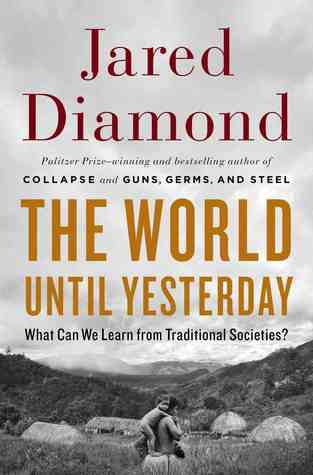
'The World Until Yesterday' by Jared Diamond


The World Until Yesterday: What Can We Learn from Traditional Societies?

I've just finished 'The World Until Yesterday' by Jared Diamond, and more than most books I've ever read, I want to share this with others.

Jared Diamond is a writer and scientist, who has spent decades researching the indigenous tribes of Papua New Guinea (this is obviously his area of expertise, but he's done a lot of research into other indigenous cultures all across the world for this book). He's most well known for his book 'Guns, Germs and Steel' about how Europeans came to dominate the world (for the answer to that, the clue is in the title!). He seems a fascinating man with a great mix of interests and fields of study. The bio on his website is definitely worth a read if you want to know more.
The book is a non-fiction book that doesn't neatly fit into any category, but instead I'd say it is a mix of geography, history, anthropology, with a bit of philosophy, science, memoir and no doubt various other things in it. The central concept of the book is looking at many different traditional societies to examine their approach to various different aspects of everyday life including crime and punishment, religion, languages, bringing up children, dealing with the elderly and diet and lifestyle. The book is called The World Until Yesterday because by examining traditional cultures around the world, many of them hunter-gatherers, the book is also examining the way all of our ancestors lived, until about 10,000 years ago (i.e. for most of 200,000 or so years that modern homo sapiens have existed for).

This concept is one that greatly interests me, because although there are many different cultures around the world, in many respects we are starting to live in one giant culture, because the vast majority of the world (certainly the Western World, but increasingly a lot of the rest too) operates very similarly in terms of the way it is run, the way people act and live out their lives. This is as a result of European colonisation in the 16th-19th century, and the spread of globalisation and American consumer culture in the 20th and 21st centuries, It is easy to assume the way people are is the only way we could be, when it is simply not true.

So the premise is one I really like, but how well did the author manage to fulfil my expectations? While not all topics are equally good (the crime and justice section at the beginning seemed to drag after a while), it was all fascinating and enlightening. The section on health was particularly excellent. Some of the conclusions were new and surprising to me, others more familiar but still had many new insights. For a knowledge junkie like me, this book was manna from heaven.

Here's a couple of quotes/facts I picked out from the book.

"Looming behind this increasing social isolation of the modern elderly is that they are perceived as less useful than were old people in the past, for three reasons: modern literacy, formal education, and rapid technological change."

"the Inuit themselves abandoned war in their own self-interest in order to have more opportunities to profit from trade, and the !Kung may have done the same"

"Roman soldiers were paid in salt, so that our word “salary” for pay is derived not from the Latin root for “money” or “coins” but from the Latin root for “salt” (sal)." [Not particlarly relevant to the thread of the book, but a fact is a fact, I never turn them down!]

"Around the year 1700 sugar intake was only about 4 pounds per year per person in England and the U.S. (then still a colony), but it is over 150 pounds per year per person today."

This wasn't the lightest read, but it wasn't particularly difficult either. I should give a shout out to the wonders of the Kindle - I did start reading this over a year ago but put it down after getting bogged down in the first section (on crime and justice). I picked it up again a couple of weeks ago, and was able to go straight to where I left off. If this had been a paper book I'd probably have taken it to the charity shop ages ago and never picked it up again!

Really enlightening and fascinating book. There were some areas I felt he didn't touch on much that I'd have liked to read about - such as more about the politics and economics of traditional cultures but maybe that is for another book. Still, for a knowledge junkie like me, this book was manna from heaven. 9/10

Sunday, 13 September 2015

Review of 'Neither Here Nor There' by Bill Bryson

I am not a die hard Bill Bryson fan by any stretch of the imagination. I've enjoyed several of his books, but there's been a couple of others I gave up on. I decided to give this one a go though because I was visiting Paris and Amsterdam, two of the cities Bryson visited in this book. I'm glad I did.
http://www.amazon.co.uk/gp/product/0552998060/ref=as_li_tl?ie=UTF8&camp=1634&creative=6738&creativeASIN=0552998060&linkCode=as2&tag=giftique-21

'Neither Here Nor There' is an account of Bill Bryson's travels in mainland Europe. He mainly travelled by train and bus, and visited many places - mainly cities - in both Western and Eastern Europe. It took me most of the book to work out exactly when the book was set, I had been thinking it was around the year 2000, but when he was visiting Eastern bloc countries it transpired that his trip took place in 1990, when many countries were on the cusp between communism and capitalism. To paraphrase Bryson, he said he was sure the place (Sofia in Bulgaria I think) would be very different in five years time, and the inhabitants would be much better for it, but he was glad he saw it before it changed all the same.

The book is not only set in 1990 however, as it features a number of flashbacks to when he travelled in Europe as a student in 1972 with his friend Stephen Katz. This allows an interesting 'then and now' comparison which I think added to the narrative.

It's interesting that of all the Bill Bryson books I've enjoyed, I've liked each one for different reasons. For instance I enjoyed 'Down Under' for all the history and interesting stories of Australia and Australians, whereas I enjoyed the autobiographical aspects and social history in 'The Life and Times of the Thunderbolt Kid'. I really liked 'Neither Here Nor There' because it made me get up and travel to a lot of these places. I really felt the excitement and adventure of travel in this book, and loved the descriptions of some of the places that made me feel like I was there (Sorrento and Lake Como both spring to mind). I also really liked the sound of Split, Croatia and Diocletian's Palace where the corridors of the old Roman Palace are now the narrow streets of the old town. I really want to visit.

This was a really good, classic travel book, easy to read with plenty of comic moments, but also beautiful descriptions, fascinating facts and the real feeling that you are travelling along with Bill Bryson at times.

I don't tend to highlight many passages in books that I read (though it is quite easy on my Kindle Paperwhite), but there was one paragraph towards the end of the book when Bryson was in Bulgaria that I wanted to quote, because I found it quite profoundly true.

"I know Communism never worked  and I would have hated living under it myself, but it seems to me none the less that there is a kind of sadness in the thought that the only economic system that appears to work is one based on self interest and greed."

Something to think on I think. I also wonder if one was to follow in the author's footsteps today, what sort of different experience they would have. Obviously, they wouldn't be travelling through communist countries, and so many Eastern European cities would be profoundly different. I suspect everywhere would be very different too, the internet and globalisation generally have dealt a profound blow to individual cultures all over the world.

Some of the adventures of travel are lost these days too - all those hours getting lost and not being able to read or understand anything would no longer be a problem. You can just pull out your smartphone for directions or instant translations when you don't understand something. My recent experience in Europe was greatly enhanced by this technology, though I was with my family and so being able to quickly find toilets, cafes, the hotel etc were really helpful.

Anyway, that's enough of being morbid. This is a great travelogue written at just the right time I think. A worthy 9/10.

Wednesday, 9 September 2015

Review of 'Amsterdam: A History of the World's Most Liberal City' by Russell Shorto

This is one of my three holiday reads, from recent holiday to Amsterdam & Paris. I started each of the three books either just before or while on holiday, but finished none of them. Holidays after all are about more than just reading. This was the last one to start, and I began (or picked up where the sample left off anyway) when in Paris the day before catching the train to Amsterdam. Part of the reason for picking it was to learn something about the history of Amsterdam to better enjoy the visit, so thought I should really start before I got there! I consequently read this straight through, and didn't put down for another book.

Anyway, on to the book. This is a narrative history book, relating the story of Amsterdam from its founding in medieval times right through to the present day. It's also an exploration of the concept of liberty, which Amsterdam has for much of its existence stood at the forefront of. If this sounds a bit high brow and technical, don't worry. While the author shares some interesting views on this, it doesn't get in the way of the main event of telling the history of Amsterdam. It just gives it a subtle extra flavour, and adds a bit of weight to the book. The story of the city it told chronologically, picking up all of the important stuff along the way, and offers us portraits of some of the most significant figure in its history. The main chunk of the book covers Amsterdam's struggle against its Spanish Catholic overlords in the 16th century, and the city's subsequent golden age in the 17th century when it was arguably the richest and most powerful city in the world. This is probably the best part of the book, but the section of Amsterdam during and either side of World War 2 is also excellent. The story of Anne Frank is of course covered, but we also get the story of another girl, Frieda Menco, who used to play with Anne and her sister, who survived the war and recently told her story to the author of this book.

The author has an insider-outsider viewpoint which I find quite useful - insider knowledge but maintaining an outside perspective to properly be able to see the bigger picture. He's an American, but has lived in Amsterdam for a number of years. He's obviously undertaken a lot of research, but also conducted in depth interviews with Amsterdamer's which really add significantly to the last part of the book.

As well as this one, his other major book which was written a few years earlier is 'The Island at the Center of the World', a brilliant narrative of history of the founding and early history of New York (originally New Amsterdam as it was founded by the Dutch). Despite covering a much wider time frame, 'Amsterdam' is a significantly smaller book in size and scope. It doesn't quite reach the heights of the author's previous work, but is still a great read.

In conclusion, this is a great book if you are looking to visit Amsterdam or interested in its history at all. There are few cities that can lay claim to the historical significance or legacy of Amsterdam, and its achievement is all the more amazing because of the short time in which it did it. The smaller stories in the book are excellent too, my favourite probably being the story about the heroics and ingenuity of Dutch resistance members during World War 2, particularly Wally Van Hall.

Really recommended, 9/10.

And Amsterdam itself? Would I recommend that as a place to visit? Well that depends. If you really like your history then definitely. It has amazing history, beautiful architecture and a lovely canal network with great boat tours. It has its seedy side too, which you can't help stumbling over from time to time (okay quite a lot really), so you'd need to not be worried about that if you were going to enjoy the city. It's got great museums, including the Amsterdam Museum which is all about the history of the city, and lots of old canal houses which you can look round.


You don't even need to go round any museums to appreciate the history though, just by walking round seeing all the old buildings will do that for you. Look out for the pictoral signs on building facades, there's lots of really interesting ones.

Final words of advice? If you are going to visit Amsterdam, be careful not to get run over by bikes - they are everywhere (they have their own dedicated cycle lanes which look a lot like pavements - be warned). Oh and take this book with you, and you'll be wowing your friends and family with fascinating tales of Amsterdam's history.

Saturday, 31 January 2015

The Rosie Project (and what makes a perfect book)

The Rosie Project by Graeme Simsion
Genre: Contemporary/comic
No. of pages: 300


Don Tillman in a thirty nine year old Genetics professor at an Australian university, and he has decided that he would like to get married. He has come to this conclusion  because studies show that married people live happier, more productive and fulfilled lives. Plus it is so much more efficient and economical, sharing the cost of living, cooking meals for two rather than one... Unfortunately he's never really had a relationship that has lasted beyond the first date, people - particularly women - do find him a bit weird, as his social skills are not very good. Also, he is very particular about the sort of woman he would be able to live with - they shouldn't drink (much), should be intelligent, must not smoke, be able to dance... One day he has the perfect idea of how to solve it - a very detailed questionnaire, so he can screen out all of the unsuitable candidates. So begins The Wife Project. He's after the perfect wife and many are unsuitable, none more so than Rosie...

Before I get on to what I thought of The Rosie Project, in the spirit of the story I would try out The Book Project and see how suitable this book is. So here's my list of what I'd need to make the perfect book.


  1. Beautiful writing, the kind of prose that really sucks you in, makes you feel like you are there, drinking in every delightful word.
  2. A good story, well constructed and not predictable.
  3. Characters that you really get to know and care about what happens to them
  4. A sense of awe and wonder
  5. Lots of really fascinating detail, where you learn a lot.
  6. A real page turner.
  7. A happy ending
  8. A world in which you can escape into and forget your real life worries
  9. The right length, not too long that it takes forever to read, but not so short that it is over too soon.
  10. An overall great feeling at the end that you've just read a fantastic book that you want to tell everyone about.
So how did this book fare? Well like Rosie, this book fails many of the criteria: the writing isn't beautiful (it isn't that kind of book, it is short and snappy rather than overly verbose), the book is nothing if not predictable and there's no sense of awe or wonder. You never really escape into it, like you would with some books, and it is not exactly a page turner though it is a quick read. So what does it have in its favour? Well I really liked the character of Don. He is rather odd by most standards but that just makes him quite endearing and I really found myself hoping and wishing everything would turn out for him. It is funny in many places, sometimes laugh out loud funny, and it has *very slight spoiler* a happy ending. And as for number 10, it did leave me with a great feeling of having read a great book (though now, a few days later this has faded a fair bit, quicker than may be the case with heavier fare).

So it fails many of the above tests, but then that's the point really isn't it? That's why you don't judge a book (or a woman) on the results of a questionnaire!

I feel I should mention one criticism of the book, which is that it isn't actually very reflective of people with Asperger's Syndrome and in fact is potentially quite insulting to them. I don't know about this, but although Asperger's is mentioned, Don doesn't think of himself as having this, and there is at most the inference that he has, it is never explicitly stated. I don't think the author intended this to be a serious book about people with Asperger's or similar mental conditions. It is meant to be a light hearted, heart warming and funny book, and in this the author has definitely been successful. I'd give this a 9/10, just. I nearly marked it down for being a bit too light and fluffy, but in the end I didn't have the heart to.


Monday, 29 September 2014

Thank You Jeeves

If anyone follows me on Goodreads, they'll notice I've been quite lax recently and not posted any reviews of books I've recently read which is unlike me so it's time to play catch up.

I've never read any Jeeves & Wooster books before, or anything by P.G. Wodehouse and I've long thought this is a gap in my reading landscape which needed correcting. So I did my research and discovered that 'Thank You Jeeves' is the first full length Jeeves & Wooster novel published, so opted for that one. There'd been lots of short stories written before, but bypassed them for now as I tend to prefer novels.

For anyone who's not heard of Jeeves & Wooster, they are the main characters in a series of comedy books by P.G. Wodehouse. Jeeves is an extremely efficient, intelligent and long suffering butler to Bertie Wooster an upper class English gentleman of average intelligence and below average common sense.

'Thank You Jeeves' starts off with Wooster annoying the hell out of everyone with his latest obsession of playing the banjo. He gets told to leave his apartment as he is regularly disturbing the neighbours, and much worse, his butler Jeeves hands in his notice as he can't stand the banjo playing either. Wooster thinks he'll manage fine without Jeeves, but is soon more in need of him that ever when his former fiance suddenly reappears in his life, and a series of scrapes and mix ups ensue.

I enjoyed my first foray into Jeeves & Wooster. The inevitable disasters which befall Wooster are comical, even a bit farcical, as are some of the ways he manages to get out of them, usually with Jeeves help (even though Jeeves isn't in his employ for much of the book). I got on with it a lot better than I do with most 'comic fiction'. Wodehouse writes really well, never quite falling into the downright silly category, and there is good description and setting, interesting characters and a plot that mostly hangs together okay. My only criticism of it was that perhaps it was a little bit long. Now it isn't a long book by most standards, less than 300 pages, but there were a couple two many plot twists and the joke was starting to wear slightly thin in places. I always find comedic fiction feels a little longer than other books as the plot doesn't carry the reader through in the same way, maybe that's just me.

So the slight length issue aside, I really enjoyed this. I will definitely read more Jeeves & Wooster, possibly by reading some of the short story collections. I can see why Wodehouse wrote so many, as Jeeves & Wooster probably suit this length of story best.

Sunday, 15 June 2014

Book review: 'Mr Penumbra's 24 Hour Bookstore' by Robin Sloan

This is a book I've had my eye on for a while (I mean books, google, secret cults, what more could you want?). It's mainstream contemporary fiction rather than science fiction, but is one geeks will enjoy. Yes you, you know who you are! Anyway here's my review which will also be going up on Goodreads soon.

Clay Jannon, formerly chief web designer at the New Bagel Company, is unemployed and looking for a job. There aren’t that many good jobs about, what with the recession and all, so when he walks past a bookshop with a job advert in the window for a night clerk he soon applies. It doesn’t take him long to realise this is one seriously weird book shop, doubling as some sort of library for a weird secret cult. Or something like that. With the help of friends including best friend from school Neal who made millions from boob simulation software, and girlfriend Kat who works at Google, he sets out to try and figure out what is going on…


This is a very fun, albeit strange book. It successfully brings together the world of old books, even older mysteries and modern technology in a way I’m not sure anyone has before. It is very up to date, and talks a lot about Google, iMacs and Kindles, OSR software and hacker communities. Computer geeks will love this book, as will book lovers. If you are a computer geek and a book lover, well you are probably already firing up Amazon to buy the book…

I enjoyed the book a lot. It was a fun book, you never quite knew what was going to happen next, and the many culture and tech references dropped in were great to see. It might have hidden mysterious and secret societies in common with The Da Vinci Code but it is not a thriller. There’s never really any great physical danger for the characters, it is much slower paced and gentler than that, and all the better for it.

I debated whether to give this book a 4 or 5 star rating. I gave it 5 in the end, it won’t be my favourite book of the year, it didn’t have characters to fall in love with, a plot that keeps you glued to the page or truly beautiful writing, but it was a lot of fun. And that’s what books should be all about.

If you are after a bit of bookspotting, well it's been a busy weekend and no opportunity to spot anything. Working from home tomorrow, then at sport's day at my daughter's school in the afternoon, so next opportunity for Bookspotting is Tuesday.

Sunday, 16 March 2014

Blue Remembered Earth by Alastair Reynolds - book review

Alastair Reynolds is fast becoming one of my favourite authors, having really enjoyed his Revelation Space series and some of his short stories. He's written quite a few standalone novels too, but for some reason decided to go for book one in his new series this time (quite possibly because I bought it on a 99p deal last summer and it's been sat in my Kindle library ever since).

While Revelation Space was set in the undetermined future (1000 years from now maybe?), and spans the galaxy with lots of weird factions of humanity and really strange tech, Blue Remembered Earth is set only about 150 years in the future. We've expanded out from Earth, but only to the Moon, Mars and a few other moons and asteroids. While there have been various scientific advances as you'd expect, there's no faster than light travel (or even near light travel) or anything else too exotic, and humans for the most part are similar to how they are today. The main advances seem to have been in some kind of bio-neural interfaces which, among other things, allow you to 'ching' across vast distances, effectively sending either a virtual representation of yourself, or your mind can be transferred temporarily into a robot (a golem) or even another human being - with their permission of course. There's also the 'Mechanism', basically an AI type surveillance and police system that literally stops you from committing a crime...


The story centers around two siblings, Geoffrey and Sunday who are members of the Akinya clan, and grandchildren of Eunice Akinya, matriarch of the family and founder of a solar system wide dynasty and business empire. As the book opens, Eunice has just died and a strange note in her will sends Geoffrey and Sunday on a kind of treasure hunt from Earth, to the Moon, to Mars...

I liked this book. Like all of Alastair Reynolds books I've read so far it has a slow start, and things don't really start happening until later on, but it is book one in the series. The whole treasure hunt thing starts to get a bit tedious eventually, but the world building is the real star, and this allows you to really build up a picture of the way things are in the 22nd century. About three quarters of the way through things really get going, and before the end you can't wait for book two, 'On a Steel Breeze'. The book does work as a standalone novel too though.

Particular credit should be given for Reynolds making Africa the dominant economic power. This is very plausible 100-200 years in the future. It may end up being the last major area of the world to become developed, but it could well be building to its height at just the right time to take advantage of space. It would be nice to think so anyway, as it hasn't had much look so far in its recent history.

Overall a great book, 9/10.

Wednesday, 6 November 2013

'Ships of My Fathers' by Dan Thompson - review

I recently asked over on Google Plus for recommendations for an 'indie' self-published science fiction book to read. I had various suggestions, several of which I intend to have a go at, but the one that most attracted me was this book, 'Ships of My Fathers' by Dan Thompson, which was recommended by Nathan Lowell (who himself is a quite well established self-published author I've now realised, and his books look rather good so you'll be hearing more from me about his books before long I think). Incidentally, the title may seem a bit of a strange one (too many plurals?), but a couple of chapters in and it makes perfect sense! Before I get into the review, my biggest reservation about self published books is the editing - other books I've experienced have been shocking, lots of spelling mistakes, grammatical errors etc. This book has none of those. It reads completely like a book published by a major publisher. Congrats to the author and their copyeditor, you've restored my faith in self-published indie books!

Michael Fletcher worked on his father's starship when, aged 17, he was suddenly orphaned after his father died in an accident. His father left him his starship, but he can't captain it until he's turned 18 and been able to pass his captain's his exam. Unfortunately, he learns that he was adopted, until he turns 18 he is under the guardianship of an Uncle he didn't know he had, and there are family secrets that need to be uncovered...

The story is a relatively simple one of family secrets, space travel and a little bit of piracy. It doesn't bore you with tonnes of descriptions, biographies, historical backplot etc, instead getting right down to the story. One thing I really liked though is that it goes into a lot more detail (without becoming boring) about life on board a starship, how it works and what people's jobs are. There's also quite a bit about how starships travel faster than light - it covers this much better than most sci-fi books which just stick with 'go to warp speed'... I was curious to know more about

The book is approximately 300 pages, and is the first in a planned series. The storyline in this book comes to a satisfactory conclusion so you don't need to read any more books, but there's enough unresolved plot hooks in there to make you want to read more. The quality of the writing (and editing) is very good - the book really flows, and there are no silly errors or clumsy writing to jar you out of the story.

Have now looked at Dan Thompson's other book, 'Beneath the Sky' the story of which is really, really interesting. A generation ship travelling for hundreds of years to the nearest star gets overtaken by a faster than light ship. What will be waiting for them when they reach their destination. Billed as being like the pilgrims on the Mayflower journeying to the new world, only to land in modern day Boston. Definitely high on my to be read list!

Saturday, 19 October 2013

Review of 'Shift' by Hugh Howey (it's amazing)

'Shift' is the sequel to the phenomenally successful novel 'Wool' and the second in Hugh Howey's Silo Trilogy. You can read my review of Wool here, but by way of a brief recap, in the near future humans live in a large underground 'silo' (think of a cylindrical 150 storey tower block buried in the ground). How they got there is a mystery but the very air outside is poisonous and as far as they are aware they are the only people left of mankind. They don't know much about 'before' only occasional picture books, strange stories handed down through the generations and the like.

In a desperate attempt to avoid any spoilers for Wool, I'll just say that Shift is a prequel that 'catches up' by the end of the book with the events in Wool. Shift is divided into three parts, or 'Shifts'.The first part of the book is a real futuristic rip-roaring thriller set initially in the mid 21st century, in a world not unlike ours today. You learn some of how the world of Wool and the Silo comes about. The end of the world scenario here is one of the scariest I've ever come about, and is definitely plausible. I've heard people say that you don't need to have read Wool to read this, and while as far as it goes this is true, you are going to get so much more out of it for having read Wool first. So please, please don't go straight into Shift. The second and third parts move forward in time and start to catch up with 'Wool'. By the end of Shift you are at exactly the same time as you are at the end of Wool (in fact I think the same conversation happens in each but I'd have to go back and check). Now normally, I don't like this kind of setup, i.e. knowing what's going to happen, but Shift isn't like that at all. They are two very, very different stories, and knowing roughly when the book ends doesn't mean you have any idea 'how' it ends or what happens to all the characters in Shift. The main characters in Wool don't appear until the final pages of Shift. One of the minor characters in Wool - Solo - has a big role in part 3 of Shift, but this is really good and fills in this characters story which I was really wanting to learn more about when I was reading Wool.

What I'm trying to say - badly - is that Shift just really works, so, so well, despite the fact that the whole prequel/catch-up mechanism shouldn't really work, not in my mind anyway. The first half of the book is in my mind (and in the opinion of some other reviewers) better than the second half, but that doesn't detract from the book at all. The first half of this book is the best fiction writing I've read this year and I've read at least 30 books so far. In fact overall I think the only book that's rivalling this year is its predecessor. Just like Wool, I'm giving this 5 stars on Goodreads. Can't wait to read Dust, which comes out in hardback next week in the UK (already out in paperback in the US), but actually is already out in the Kindle store - whoop!